
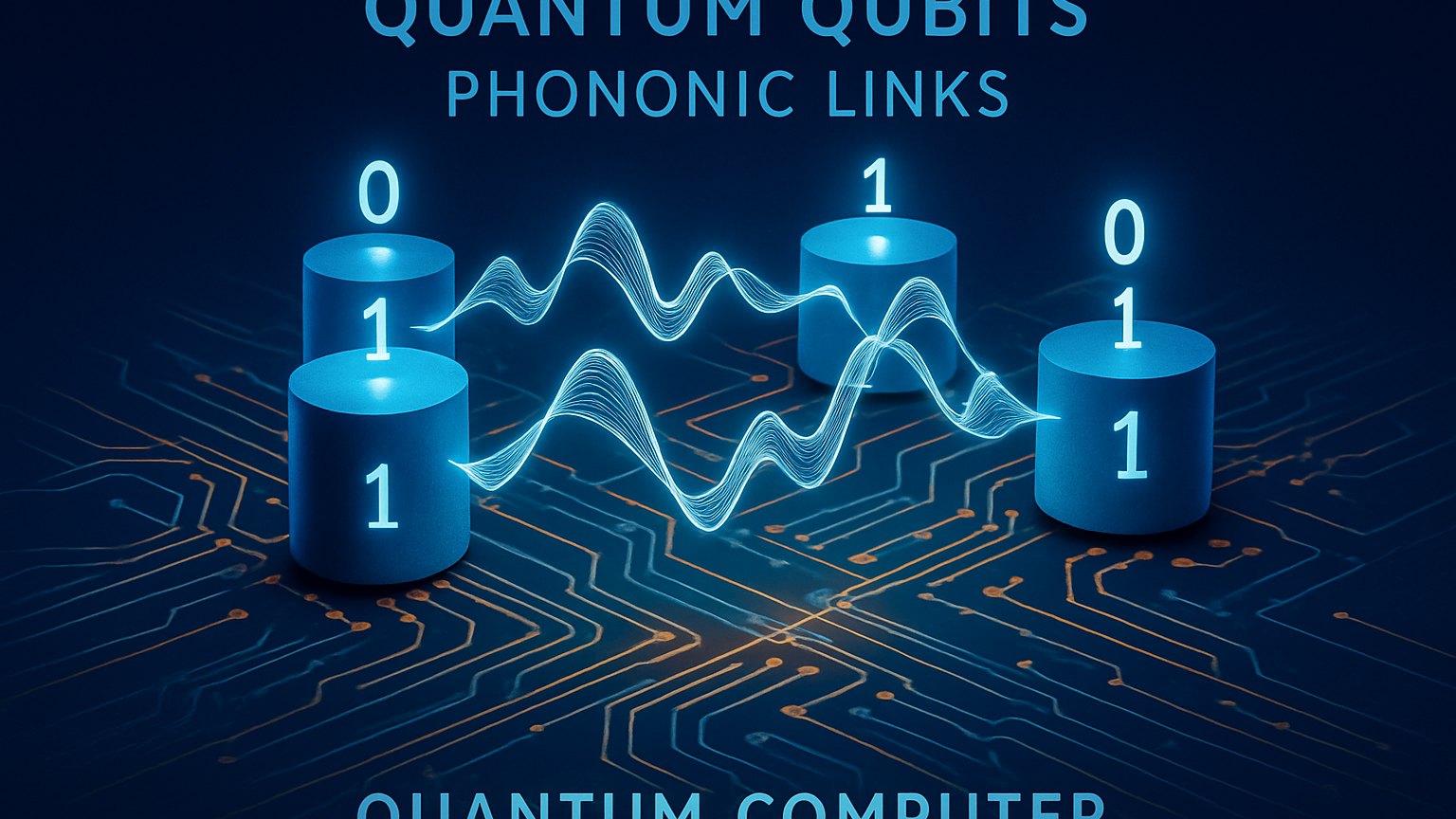
What are Quantum Phononic Links?
Quantum Phononic Links (QPLs) are an innovative method of utilizing phonons—quantum mechanical excitations of lattices in solids—to facilitate communication between qubits over long distances. Unlike traditional methods that often rely on photons, which can suffer from decoherence and scattering in materials, QPLs leverage sound waves at the quantum level for transferring information.
Phonons, as quasi-particles, offer a compelling alternative for qubit connection, particularly in solid-state quantum systems, because they can be manipulated more reliably than photons in various environments. Current research has begun to explore their capabilities to transport quantum information efficiently, potentially overcoming significant limitations in existing quantum computing architectures.
The Significance of Long-Distance Qubit Communication
Enabling Scalable Quantum Networks
One of the main challenges in quantum computing is scalability. Most existing quantum computers operate with qubits that are entangled in localized systems, which limits their ability to effectively communicate with distantly situated qubits. By using QPLs, researchers can facilitate inter-qubit communication, potentially forming a scalable quantum network.
This scalability is critical as it paves the way for distributed quantum computing systems, where qubits positioned far apart can operate cohesively without significant loss of information. This is especially important for applications requiring high computational power, such as cryptography and complex simulations.
Increasing Robustness Against Decoherence
Quantum information is notoriously fragile and prone to decoherence due to environmental interactions. QPLs present an alternative mechanism that might be less susceptible to such decoherence compared to photon-based systems. Their reliance on acoustic waves can offer a more stable medium for transferring quantum states, making the communication process more robust in various conditions.
According to a recent study published in Nature, experiments have indicated that phonons can maintain coherence better than photons under certain circumstances, although further research is needed to fully understand their potential and limitations.
Current Developments in Quantum Phononic Links
Research Milestones
Recent advancements in quantum phononic technology have shown promising results. Researchers at institutions such as the Massachusetts Institute of Technology (MIT) have made significant strides in fabricating high-quality phononic devices that can generate and detect phonons effectively. Their prototypes demonstrate the feasibility of transmitting quantum information over distances that exceed what is currently possible with conventional qubit communication methods.
Additionally, groups in Europe, like those at Delft University of Technology, have produced results showcasing the potential of QPLs in hybrid systems combining different quantum technologies, suggesting a pathway to integrate phononic links into existing architectures.
Experimental Challenges
Despite these advancements, using QPLs in real-world applications is not without its challenges. The integration of phononic devices into quantum computing systems still requires overcoming various engineering hurdles, such as maintaining precise control over phonon interactions and ensuring low energy losses during transmission.
Moreover, the current limited understanding of how phonon-based communication interfaces with larger quantum networks necessitates deeper investigation.
Implications for Quantum Computing and Beyond
Advancements in Quantum Technologies
The potential implementation of Quantum Phononic Links could become a game-changer for quantum computing and related technologies. By enabling high-fidelity, long-distance communication, QPLs could unlock new capabilities for quantum algorithms that depend on extensive data exchange. These advancements could lead to innovations in machine learning, quantum machine vision, and practical quantum cryptography.
Moreover, the study of phononic systems could also give rise to new materials with extraordinary properties, further enhancing quantum architectures with the requisite robustness needed to sustain long-term quantum operations.
Future Outlook
While current research shows substantial promise, the future of Quantum Phononic Links hinges on solving practical implementation challenges. Persistent collaboration among quantum physicists, materials scientists, and engineers will be paramount to overcoming these hurdles.
Although the prospect of integrating QPLs into mainstream quantum computing is still a budding field, early indicators suggest it holds considerable promise for the next generation of quantum technologies. Continued funding and research in this area may accelerate breakthroughs, enabling the realization of large-scale quantum networks.
In conclusion, while Quantum Phononic Links are still in their early stages of development, their potential implications could redefine how quantum systems communicate, making them more scalable and robust against environmental challenges.